
What does daily life look like for someone who lives as a Market FIRE investor? For anyone who wants to actively manage an investment portfolio as a primary means to enjoy financial independence before conventional retirement age, there are several important actions that should be made into part of a routine.
Actively trading one’s portfolio essentially amounts to a private business enterprise that can give investors a full- or part-time self-directed job to match the time available after an investor has given up conventional full-time employment. Even though one objective likely is to eliminate the needless turmoil, stress, and/or monotony of the employment that preceded financial independence, actively managing one’s investment portfolio does require consistent time and effort. Your chances of success with Market FIRE will be increased if you diligently attend to the routine steps described in this piece.
I. Be “On Call” During Regular Stock Market Hours
At a basic level, though not necessarily glued to the computer, a Market FIRE-oriented investor should consider himself to be “on call” during regular stock market trading hours, so that any of the below steps can be observed. In the USA, these hours are from 9:30 a.m. to 4:00 p.m. Eastern Time on Monday through Friday. The stock market is closed on a lengthy list of holidays that are observed during the regular work week–indeed one that is more generous than most employers in the private sector and even many in the public sector.
This does not mean that an active Market FIRE investor needs to “work” with studying and investing continuously throughout the day, even on every non-holiday weekday. Instead, it means that such an investor should be able and ready to take some action to buy or sell stock or options on any such day, depending on economic and market developments that may arise each day. Even if there is no buying or selling on any given day, the investor will still need to log into the online brokerage account, assess each day’s portfolio and overall market performance, and consider any major market-related news developments.
By all means, even during a part of the regular trading day, an active investor still can take a long lunch, meet with friends, go to the gym, play with the family dog or cat, go shopping, read something completely unrelated to the financial markets, or attend to unrelated part-time or freelance work — provided that he still takes some time during the day to “check in” with the markets every day and check the portfolio (almost) every day and otherwise finds time to do the routine actions described in this piece.
Additionally, at least on occasion, an active investor can go out of town, whether to some event on a given day or to the beach or other favorite relaxing spot for multiple days, so long as the investor takes care of any short-term pressing issues (often involving stock options) beforehand and is also able to check in on any urgent market developments, which can usually be done with only a smartphone or tablet.
And even when not otherwise in “vacation mode,” a Market FIRE-oriented investor should be able to enjoy a change of scenery and work at managing the investment portfolio at someplace other than one’s regular place of residence, whether at the house of a close friend, in a coffee shop, in a country retreat, or out in nature (as long as there is reliable internet access).
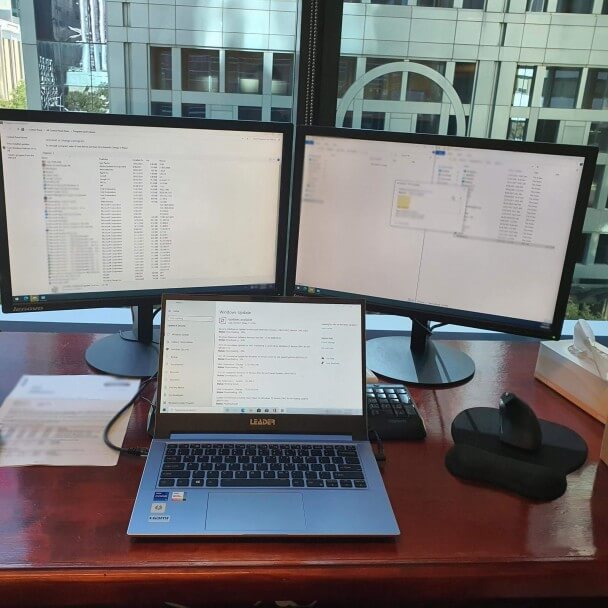
Unless the investor is on vacation or otherwise traveling off-site, it is best that the investor’s work as a market investor take place at a dedicated workstation at home, with a desktop or laptop computer at a desk or table. This can be done in a home-office, living room, dining room, or bedroom, as long as these areas are reasonably quiet. It may be helpful to have an extension monitor as well, especially if the investor is using a laptop rather than a desktop. The mobile apps made available by online brokerages, while useful for conducting business when away from one’s work site, generally do not offer the full range of information that an investor has access to on the regular online account on the brokerage’s full website. Moreover, having two or monitors will facilitate multitasking, in the form of having one’s account holdings up on one screen, possibly relevant charts open on another screen, and streaming TV news open on another screen.
II. Monitor Macroeconomic News and News Specific to Stock Holdings
A Market FIRE investor must be able to regularly monitor the relevant news. This means he should be regularly monitoring macroeconomic developments and any specific news and developments regarding individual stocks already in the investment portfolio.
Monitoring of news on the macroeconomic level can be done by reading a favorite financial news publication, such as the Wall Street Journal, and/or by watching at least one regular financial television news show, such as many of those on CNBC, Fox Business Channel, or Bloomberg TV. The investor should be aware of major economic conditions, including interest rates as set by the Federal Reserve and bond market, employment figures, consumer confidence, manufacturing activity, and federal budgetary matters. General non-financial news, such as political and international news, should also be monitored to some degree in order to maintain a well-rounded perspective of awareness of events, which may also have the potential to affect future market developments.



Consistent monitoring of company-specific news can most easily be done using any number of internet sources that provide news–often times from other sources–for any company selected. This type of monitoring can be done on the online accounts associated with most online brokerages, as well as through manually entered watchlists using Yahoo! Finance or the Apple Stocks mobile app. At least occasional review of analyst reports and ratings on stocks held in one’s portfolio (such as CFRA and Morningstar) should also be done through the online brokerage account.
Additionally, company-specific developments would include quarterly earnings reports, which should nearly always be monitored in some fashion. When an investor wants more information about a particular earnings report, he should consult as a primary source the quarterly written report that each company files with the SEC and/or a transcript of the quarterly earnings conference call that company management conducts with market analysts. The well-informed investor should also maintain some degree of awareness of earnings reports of major companies that may reflect the economy’s overall health, even if those companies are not in his portfolio. Such companies may include Apple, Amazon, Walmart, Caterpillar, General Motors, or JP Morgan Chase.
Although this type of news monitoring does not always need to be done during regular stock market trading hours, it is most helpful if at least some of it is usually done during these hours, so that any trading actions can be tailored to the most up-to-date developments. In particular, news about more macroeconomic developments and headlines regarding quarterly earnings reports (though not necessarily review of the earnings reports or conference calls themselves) may be most helpful when done during regular trading hours. For those comfortable with multi-tasking, this type of news assessment can be done in the background while monitoring one’s own investment portfolio and placing any appropriate stock or options trades.
III. Monitor Daily, Monthly, and Year-To-Date Portfolio and Market Performance, Including Charts and Technical Indicators
In conjunction with the Market FIRE investor’s monitoring of daily news developments, the investor should also daily (or at least near daily) monitor the daily, monthly, and year-to-date performance of his own portfolio and the market as a whole. Generally, this will entail logging onto the investor’s online brokerage account and checking the price changes of stocks held and the major market indices.
In addition to basic daily price monitoring, the investor should keep track of certain performance metrics, both formally and more informally on an ongoing basis, in order to assess satisfaction of overall financial independence objectives. As outlined separately on this website, a Market FIRE-oriented investor should maintain a spreadsheet to keep track of monthly net options premium generated and yearly portfolio performance.
Although it may not be necessary to record more frequent performance data on a spreadsheet, the investor should periodically check individual stock, overall portfolio, and overall market performance on an ongoing monthly and year-to-date basis. For stocks against which covered call options have written, the investor should keep track of not only the unrealized loss or gain of the underlying stock but should also calculate the total options premium generated for those individual stocks. Consideration of this information will result in a more complete, and often more favorable, assessment of a stock’s performance, even if there are unrealized gains on underlying shares.
The investor should also maintain ongoing awareness of the level of realized gains and losses for the overall brokerage account. This step is important to monitor the adequacy of cash flows. It is also crucial in order to ensure compliance with federal (and possibly state) tax laws. Because capital gains on stocks are not generally subject to income tax withholding, a Market FIRE-oriented investor will need to be prepared to pay estimated capital gains taxes on a quarterly basis, depending on the calendar established by the IRS. State and local tax requirements in this area vary. Regarding federal quarterly estimated tax payments, this should be done in order to avoid having to pay additional penalties and interest that may be due by the regular annual tax return deadline if capital gains taxes have not been pre-paid.
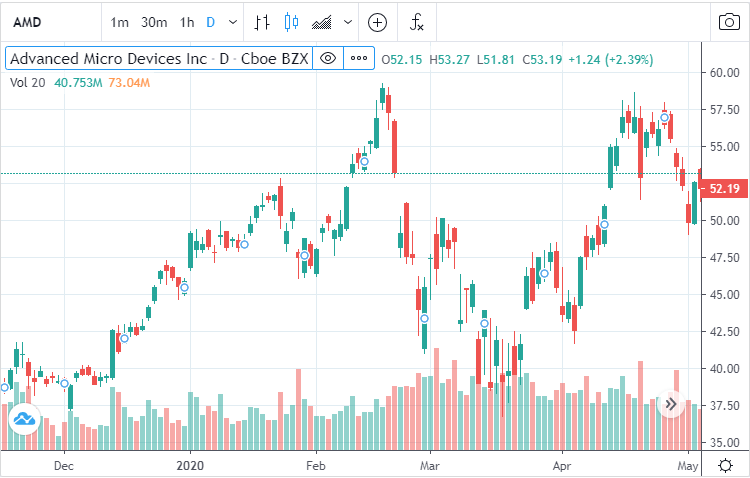
As part of the monitoring of portfolio performance, an investor should periodically review appropriate valuation metrics for stocks held in the portfolio. This type of analysis these allow an investor to be aware of possible stocks that may need to soon be liquidated or may justify acquisition of additional shares of stock. For most stocks, valuation assessments will include the current and forward estimated price/earnings ratio. For financial institutions it will include the price/book ratio. For currently unprofitable high-growth technology and other type of companies, it will include the price/sales ratio. An investor will want to compare these figures to average industry valuations and recent historical valuations for the same companies.
Besides numerical performance of individual stocks and the portfolio and market as a whole, a Market FIRE-oriented investor should also keep track of charts and at least some select technical indicators for stocks held in the portfolio, prospective future stocks that the investor is interested in acquiring in the future, and the major market indices. This step should be taken routinely so as to assess current and possible future price trends, which in turn may inform buying or selling decisions about stocks and options associated with those stocks.
There are numerous possible technical indicators. It would be unrealistic for most investors to expect to be familiar with all or most of them, let alone to regularly monitor them for particular stocks. The investor instead should select a small handful of useful indicators and use them, in conjunction with commentary by specialized analysts in the area, sometimes referred to as “chartists.” Possible recommended indicators and concepts include 200-day and other length moving averages, MACD (Moving Average Convergence/Divergence), RSI (Relative Strength Indicator), resistance and support levels, double top formations, higher highs and lower lows versus lower highs and lower lows, regular and inverse head and shoulders formations, and cup and handle formations.
IV. Assess Portfolio Cash Position and Personal Cash Flow Needs
Any Market FIRE-oriented investor should also routinely assess his own portfolio and overall personal cash position in conjunction with his personal cash flow needs. After all, unlike for people who plan for conventional retirement, assets are meant to be harnessed to generate cash for ordinary living expenses for anyone who has achieved financial independence at an age earlier than conventional retirement. Simultaneously, new excess cash will need to be leveraged into investing in additional assets that will have future cash flow potential. This means that the Market FIRE investor will need to routinely ensure that he has sufficient cash for near-term budgetary requirements and expectations. Generally this will mean having the equivalent of at least six months of living expenses available in either the cash portion of the brokerage account or another liquid savings or checking account.

If the cash position is currently running or will soon run on the low side of what the investor feels comfortable in maintaining, then the Market FIRE investor should determine which assets will need to be used to generate cash in the near future. First, expected dividends that have already been declared or are anticipated to be declared based on recent practice should be considered. Second, covered calls on shares of stock that are currently unencumbered by short calls should be considered, with possible current options premium levels in view based on feasible possible strike prices and expiration dates. Third, underlying stock positions should be identified as possible candidates for liquidation as a source of cash, with priority to stocks that have experienced substantial unrealized gains in value.
Provided that an ample cash cushion for immediate expenses is in the bank, none of these sources of funds needs to imminently tapped. The purpose of this part of the routine is simply to identify likely near-term future sources of funds, in such a way that will allow the investor to also approximate the amount of funds expected to be generated from these sources.
When more cash is in the account(s) than is necessary for the next six months of living expenses, then a Market FIRE investor should identify additional prospective positions of stock that he would like to acquire or any long call or put options that he would like to purchase. Prospective additional positions of stock may well be in companies in which the investor already holds stock, which would involve potentially increasing the position in those companies. Alternatively, they could be new positions in companies in which the investor does not currently hold stock. These companies would be identified as strong candidates based on the news, technical monitoring, and analyst research referenced earlier in this piece.
As with situations in which the investor intends to soon generate additional cash, an investor seeking to deploy excess cash does not need to do so immediately. The purpose of this part of the routine likewise is to identify likely near-term suitable investment candidates against which to deploy excess cash, along with the approximate amount that should be devoted to each potential new investment.
V. Make Any Appropriate Options and Stock Trades
From the list of suitable investments to either sell to generate cash or buy using excess cash based on the step above, the Market FIRE investor then needs to be ready to make any appropriate options or stock trade at an appropriate point of time in the market. The precise timing may generally be based on short-term market conditions for an individual security.
For instance, it will often be preferable to buy a desired stock or option on a trading day in which the underlying stock is declining in value off of recent higher levels, or at least is not increasing dramatically in value. Likewise, it will often be preferable to sell a stock or option on a trading day in which the underlying stock is increasing in value off of lower levels, or at least is not decreasing dramatically in value.
Immediate levels for technical indicators, such as the Relative Strength Index (or RSI) may also be consulted to pick a desirable time to buy or sell. Exact current valuations of the companies should also again be checked before placing any orders to buy or sell stock.

The frequency of trades may vary considerably. In times of high market volatility, it may not be unusual for a Market FIRE-oriented investor to place options trades related to covered calls every trading day — often several trades on a given day. Usually there may be more activity in buying to close covered call options on significant downward trending days for the overall stock market. LIkewise there may be more activity in selling to open covered call options significant upward trending days for the overall market. On some trading days where news events in the middle of the day (such as the release of major economic statistics or a Federal Reserve press conference) cause the direction of the market to change, there may be several trades involving both selling-to-open and buying-to-close covered call options.
Stock trades will generally not be done as frequently as options trades. Nonetheless, new stock positions should generally be bought with some degree of regularity with new cash, at least quarterly when prices are considered to be attractive. For sales of stock positions, if these are encumbered by outstanding covered calls, then these sales will need to take place in two steps — first, by buying-to-close the covered call option OR allowing the option to expire worthless, and second, by selling the underlying stock.
These steps to sell stock may occur over multiple days or even with weeks separating the two steps, with closure of options often occurring on a down day or short-term trend for the stock and selling the underlying stock often occurring on an up day or short-term trend for the stock. The sale of the stock could also be effected in one step if the investor simply allows an outstanding covered call option to expire in-the-money, such that the option will be exercised and the stock liquidated at the chosen strike price. However, this may not be preferrable unless the investor wants to sell the stock and the market price around the time of option expiration is only slightly above the option’s strike price.
CONCLUSION
Day-to-day life may take on different forms for each Market FIRE-oriented investor or even on different days for the same investor, but routinely following the above steps should give some degree of structure to whatever hours the investor chooses to make as that investor’s working “business day.” The Market FIRE investor will benefit from having a dedicated workspace available to use during regular trading hours, regularly monitoring macro-economic and stock-specific news developments, monitoring market and portfolio performance, assessing one’s personal cash position, and making appropriate stock and options trades. Together these routine measures should make each day a productive day of working for oneself in the stock market. If done consistently over a long enough period of time, these measures should hopefully also allow for a prosperous time for the Market FIRE investor.
 Stock Market FIRE.com
Leave a comment